Kilns, dye pots and jetty posts – this summer’s build progress so far…
This time round, we thought we’d hand the blog over to the people doing the digging, dyeing and building themselves. Below you’ll find updates from across our heritage sites, each written by the volunteer or archaeologist leading that piece of work – so you’re hearing straight from the Roman textiles team, the kiln reconstruction, the Roman garden and the Bronze Age jetty, in their own words.
Over the past few months, volunteers in all of our heritage projects have been working exceptionally hard, and, true to form for Britain, in some very challenging weather conditions including torrential rain deluges to red alert heatwaves (hint, clay doesn’t do well in either!)
If you have the chance to explore these areas on your next visit then please do – we are at the wonderful stage where there has already been so much progress made, and it is a testament to the determination and enthusiasm of those volunteers for creating these amazing spaces.
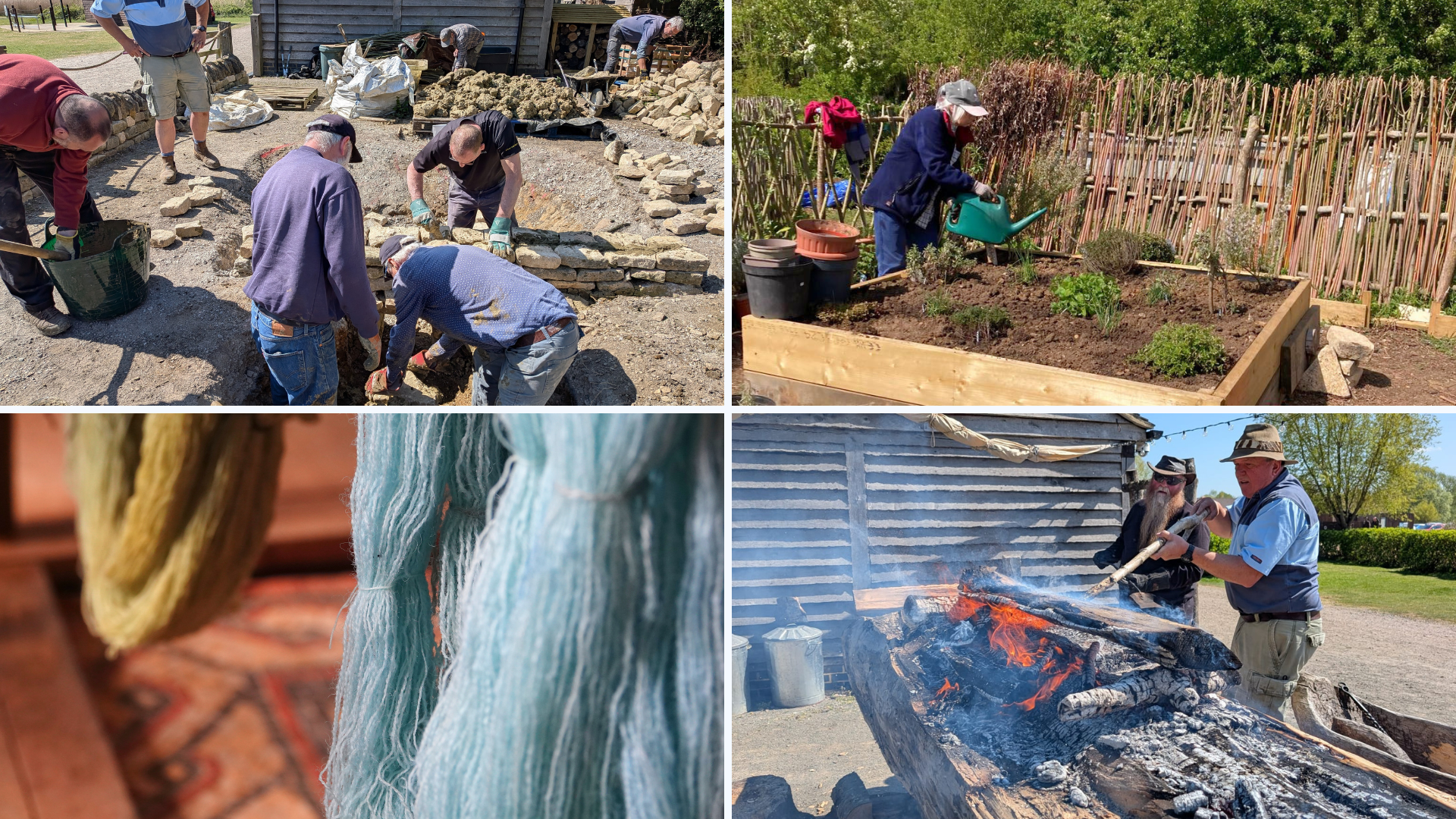
The Roman kiln construction is moving along well despite the weather, and the Roman garden is truly blooming and is definitely taking shape. The Northants Guild of Spinners, Weavers and Dyers have been starting on their natural dyeing experiments with weld, and at the Bronze Age jetty, volunteers have been sorting and preparing a number of wooden posts to be used as uprights or split into planks for the boardwalk. You can read their updates below!
Dates for the diary:
Our next heritage build weekend will be on the 1st and 2nd August, part of the national Festival of Archaeology. Followed by the fantastic Heritage Open Days on 20th September. We hope to see you there!
Nadia – Heritage Coordinator
Roman Textiles – Kerry Sowells, Volunteer
Dyeing the Roman way
We are aiming to show how the dyes that the Romans in Britain would have had available stand up to use today. We will dye samples using a mordant that was used by them, and others without, to see the difference it makes and how lightfast the colours are. We are using wool, silk, cotton and linen cloth. These would have been used by the Romans, although wool would have been the most popular fabric as it was the cheapest and most readily available at the time.
The mordants used are potassium aluminium sulphate for animal protein fibres and aluminium acetate for cellulose fibres. These are natural metallic salts that help the dyes adhere to the fibre and keep the colour bright.

Weld has been used for dyeing in Europe as far back as the Iron Age, and we know that the Romans used weld for yellow throughout their time here. According to Pliny the Elder, yellow was traditionally worn by brides.
We used 65g of fresh weld flowers grown in the Guild Garden at Stanwick Lakes. Only the flower tops were used.
The weld flowers were simmered gently for one hour, then the fibre – which had been soaking in water for an hour – was squeezed out and added to the dye pot. The flowers were left in the pot and everything was simmered for another hour. After an hour the heat was turned off, and it was cooled for twelve hours before the fibre was removed, gently rinsed under cold running water and left to dry naturally inside.
In this second picture, the fabrics are cotton, linen, wool and silk.
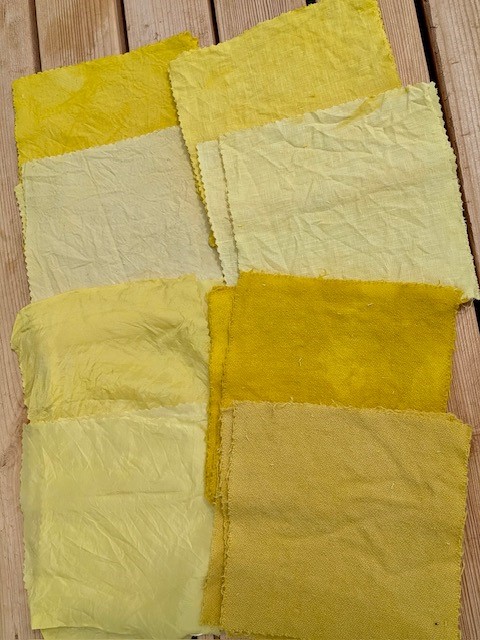
There is an obvious difference between the mordanted and non-mordanted fibre, which was expected, and shows the importance of this preparation step.
Roman Kiln – Derek Roberts, Archaeologist
Reconstruction of a Roman Updraft Kiln
Work went well on the initial setting out of the Potter’s Yard. The existing wall was dismantled and realigned to create a yard large enough for the kiln and associated activities. The redesigned wall, featuring a low stone wall with timber posts and rope balustrade, also provides visitors with a much better view of the kiln during construction and firing.
Excavation into the natural sand, gravel and clay substrate progressed well, with only wet weather slowing work. Groundwater never became an issue, allowing the firing chamber and stoke pit to reach depths comparable with the representative kilns excavated at Stibbington.
Stone recovered from the original wall was reused to construct the kiln façade and flue, producing a structure remarkably similar to Kiln W from Stibbington.


Processing the wild clay proved slow and labour-intensive but successful. After slaking, sieving and drying, the clay was used to line the kiln chamber, construct the pedestal and produce the kiln bars.
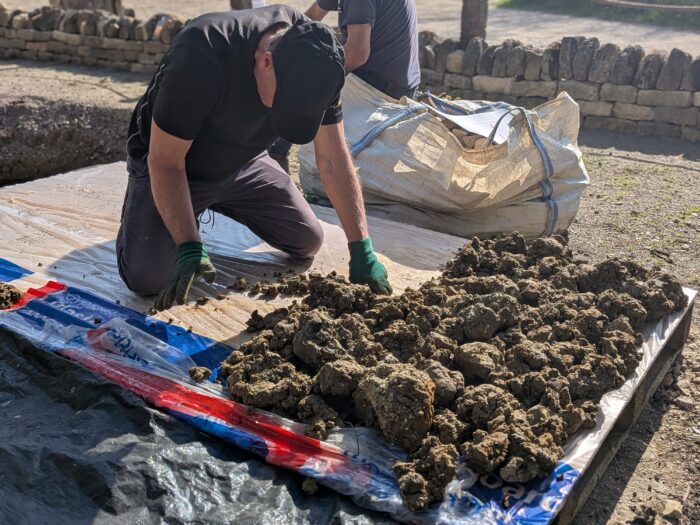
The weather provided valuable lessons. Hot conditions caused the chamber lining to crack, closely resembling those seen in Kiln G at Stibbington, while prolonged heavy rain caused sections of the lining to collapse. These results suggest the Romans would have carefully chosen the season for kiln construction, most likely from late spring through summer and into autumn.
Different methods of making kiln bars produced mixed results. Bars formed in timber moulds cracked during drying, while freehand bars proved far more successful.
Around four tonnes of wild clay have now been processed for both kiln construction and replica Roman pottery. The refined clay has produced a range of successful replica vessels, together with a shrine and goddess figurine for use throughout the kiln’s working life.
Summary Despite the challenges of weather and local geology, the experiment has demonstrated the versatility of the chosen clay and the value of practical experimentation. A team of complete novices has successfully constructed a Roman updraft kiln and produced high-quality workable clay. The next challenge will be learning how to fire the kiln over the coming months.
Roman Garden – Amanda Philips, Volunteer
The Roman garden has come on leaps and bounds over the last couple of months.

The raised beds have all been completed and coated with preservative, all the plants have been planted up, and balk-shaped terracotta pots have been buried in the beds for a slow-release watering system – just like the Romans had.
Two hops have been planted on the side fences to give a soft cover along the boundary.
The Rosa Gallica put on an amazing show this year even though it has only just been planted, and already 5 beetroots have found their way to the Stanwick Lakes kitchen from the Roman garden.

Foundations for the fresco wall are in place, and the two pillars at the entrance to the Roman garden are well underway.
Boat Build and Jetty Build – David Buchanan, Volunteer
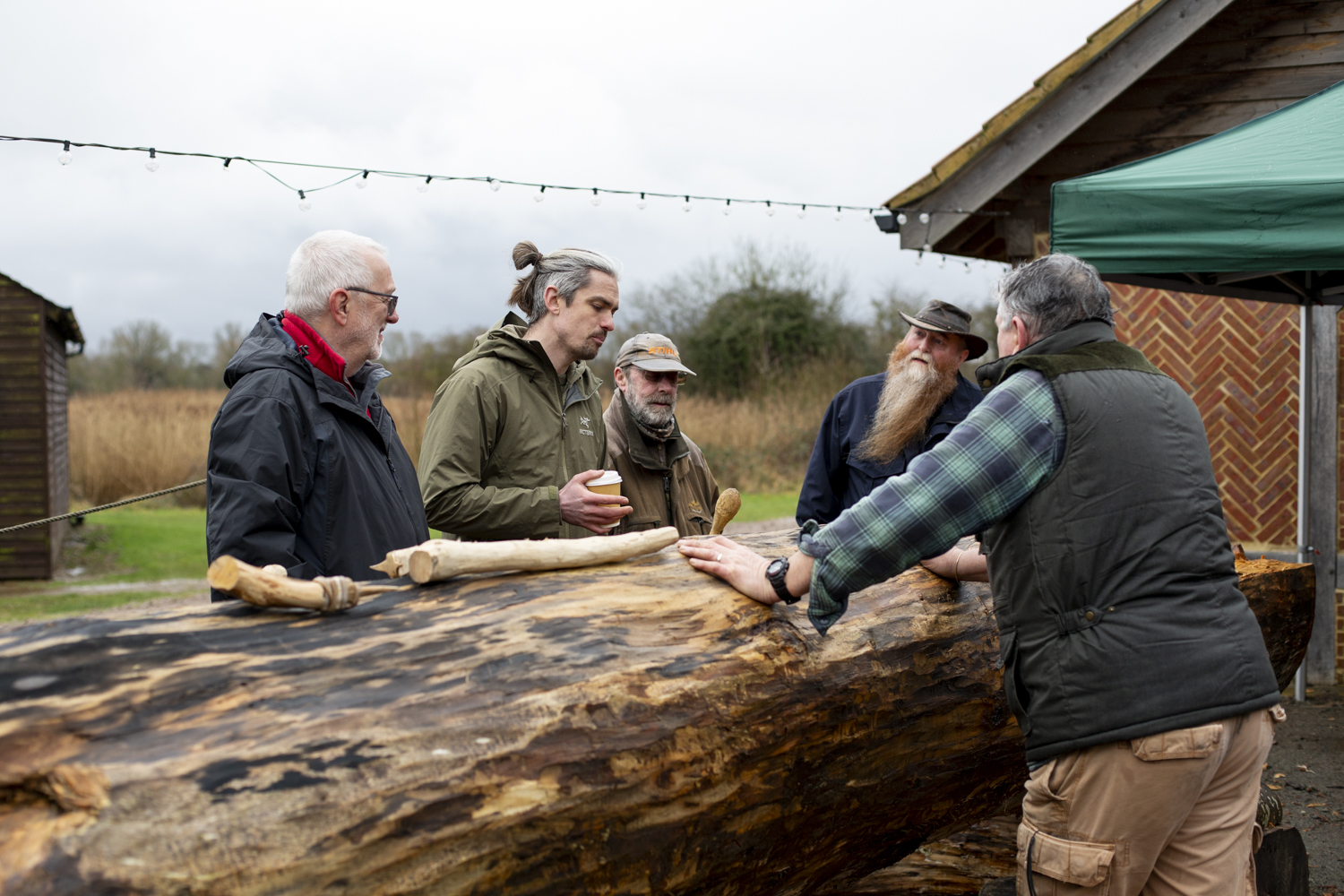
Through hail and heat we’ve dug holes, stripped bark and bled.
From the timber pile we select either short or long, crossbeams or uprights (uprights that are in water are oak for longevity).
We then have to strip the bark, place the post in the hole and pack it with rocks.
If the posts are going in the water, we create a spiked end and burn it so it doesn’t rot. Once in the right spot, it’s hammered in from a platform above.
Many types of crossbeams have been discussed, and we’re going to try them all.
So far, we’ve tried a simple wedge cut-out, and a notch and rope joint. We are going to try a type of tenon and pin once we get a stable platform out over the water.
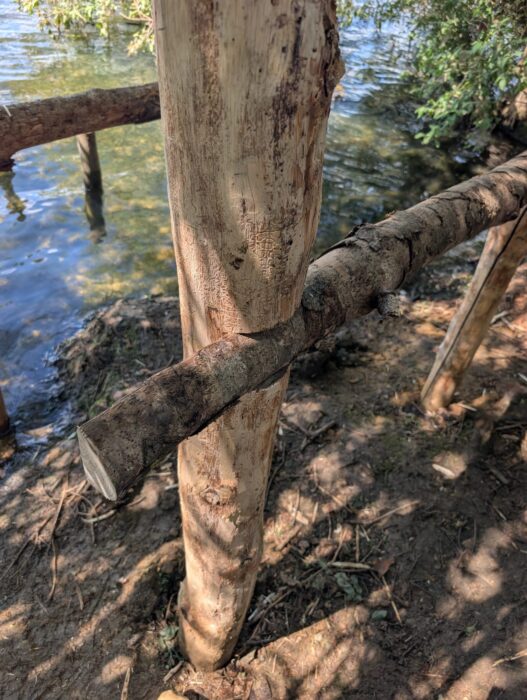
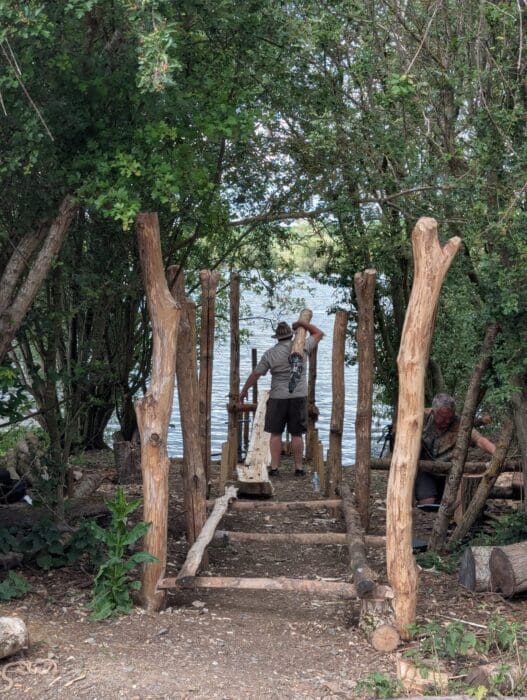
A season to be proud of!
From the first cuts into wild clay at the Roman kiln to the first bunches of weld gathered for the dye pot, and from beetroots pulled from the Roman garden to timbers driven into the riverbed at the jetty, it’s been a summer of real progress across every one of our sites – built, quite literally, by hand, and often against the weather rather than with it.
None of this happens without our volunteers, and we can’t thank them enough for the hours, the graft and the enthusiasm they’ve brought to every project this year. If you’ve enjoyed reading these updates, the best way to see the work for yourself is to come along in person – join us at the heritage build weekend on 1st–2nd August for the Festival of Archaeology, or drop by for Heritage Open Days on 20th September. We’d love to show you around.
Nadia – Heritage Coordinator